I wonder if Joe Klipfel owns a table.
His game design philosophy seems to be: I like this game, but can I play it while standing in line at the deli?
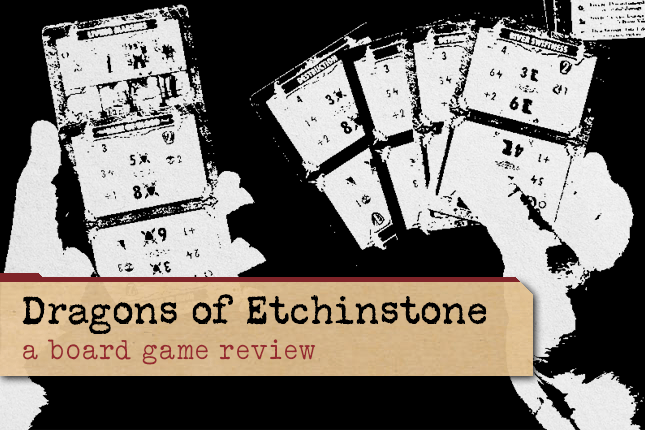
In Dragons of Etchinstone, a solitaire game designed by Klipfel, you hold a deck of cards in your left hand, representing your draw pile and a set of challenges. Then you play cards from your right hand to defeat them.
Or, if you’re like me, you set everything on a table. I don’t trust myself. I’m clumsy. All it takes is one fumble and the game is ruined. With a table, I’m fine until I knock the table over or burn the house down.
Speaking of fire, you play as a wizard adventureman—sorry, an “Ether Mage”—on a quest to kill a dragon. The dragons have occupied strongholds in the four corners of Valorfall and need to be stopped before the peasants learn how to file insurance claims.
On each turn, you draw four cards. These represent your skills, abilities, and magical spells. The top card of the draw deck tells you what obstacle you face this round. This will either be Combat or a Journey. Both are handled about the same.
You play three cards to overcome a challenge. Each card fulfills a different mechanical role and activates different elements on the card. Figuring out which cards work best in each role is the central logic puzzle of the game.
The first card is the Leader. There are two actions listed in the center of each card. One is basic and can be used without restriction. The other has a colored background and only activates if it is “infused” by the second card, the Element. Infusing only works if the color of the Element card matches the background of the action.
The Element also determines your initiative. This is important in combat. If you don’t beat the initiative, you run the risk of taking damage before the fight even begins.
Your third card is the Booster. This gives you bonus points that can be spent either to increase the action value on your Leader card, or to bump up your initiative.
The fourth unplayed card usually remains in your hand into the next round.
As you can see, Dragons dives headfirst into gamey abstraction. This is the point where most games lose me. I’m a narrativist. My enjoyment of a game derives from how well it tells a story. If the mechanics of play are too abstracted from the action of the unfolding story, I struggle with it. In Horrified—another game I love despite some narrative nonsense—isn’t it odd that you might go into battle with Dracula wield a fire poker, a canopic jar, and a kite? Maybe the crossbar reminds Vlad of a cross.
In Dragons, I guess we’re to assume that the cards symbolize us weaving an arcane spell together? It’s a little thin. There’s a delicious Netrunner-esque retheme lurking in the back of my head that I think would be way better. But the core gameplay loop is so engrossing that I don’t care.
If you overcome the challenge, or reduce the challenge’s value by half, then you earn experience points. You spend these to upgrade your cards. Each card is divided in half and there are alternate front and back sides. This gives each card four possible permutations. Deciding which to upgrade is a cornerstone of your strategy. But so is knowing which cards to downgrade.
See, your cards also act as your health in combat. Each has a shield value on it that can absorb a set amount of damage. If the card takes a hit, then it gets downgraded one level. Reducing a card below level 1 means it is removed from the game. Ouch. Each card can only be downgraded once per encounter. So, if all four cards have 2 Armor and you take 9 damage, then you’re going to have a bad time.
During Journey encounters, you don’t have to worry about soaking damage. Instead, you suffer time penalties. This means taking cards off the draw pile and discarding them. When the deck runs out, you move into the next region and face off against even tougher obstacles. Complete the fourth region and you head into the final battle with the dragon.
There’s a ton of nuance here—especially when you consider that the entire game is just 18 cards. Eighteen! And I’ve only just scratched the surface. There are also different colored armors, which absorb and protect against different damages; fusing cards together to form a wildcard color at the cost of depleting your deck faster; ways of dealing double boosts during journeys, icons that add one-time modifiers to your encounter, and more.
There’s a lot to the game. Which leads to my one real negative opinion: Dragons of Etchinstone is simple to play, but hard to learn. I read the rulebook a few times and could not grok how it all fit together. I bounced off it like a Nerf dart on a Sherman tank. There were too many terms and icons and numbers and mechanics. Looking at the cards was no help. They look like if J. R. R. Tolkien wrote math flash cards. They are impossible to decipher without guidance.
I almost gave up on the game until I remembered we live in a world of Let’s Play videos. A few of these under my belt, everything became clear. I think it’s a game you really need to see in action to understand. Or maybe that’s just my hangup.
Regardless, Dragons of Etchinstone is a wonderful little puzzle. It’s a solid piece of design that provides a wonderful dollop of brain friction. I can’t recommend it enough. Why not go down to the deli RIGHT NOW, stand in line, and give it a play.
I’m sure no one will look at you strangely.
 Joe Johnson Writer
Leave a comment