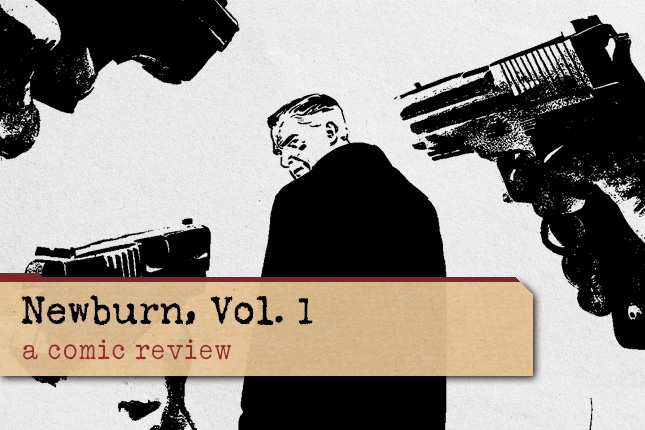
When a mafioso turns up dead in a crummy apartment and several kilos of coke go missing, Easton Newburn takes the case. He’s a former police detective turned private investigator for the mob. The cops are willing to look the other way, because Newburn keeps the peace between the rival New York crime syndicates.
Nobody touches Newburn. His word is law, his results unquestioned. He’s unflappable, cold as ice, loyal to no one. He faces down cops and criminals alike. He goes where he likes, when he likes, always the consummate professional in a sleek business suit, never betraying a single emotion.
Uh-huh. Are you rolling your eyes yet?
Newburn, the graphic novel, collects the first eight issues of the comic book series written by Chip Zdarsky and illustrated by Jacob Phillips.
I’m a sucker for stories about criminals and private eyes, so this should have been right up my alley. But I ultimately found it disappointing. That’s mainly because the whole setup feels laughably half-baked. It wants to be gritty and noir, but it doesn’t ring with any authenticity. It’s missing that subtle note of melancholy and hopelessness that underpins the best works in the genre.
The whole premise that Newburn operates with carte blanche immunity is hard to believe when he is constantly being questioned and threatened by his employers. Wait, I thought he was untouchable? Nobody can lay a hand on him, but when they learn he is investigating a case for the police—which he literally does in every issue, because his ability to navigate both sides of the law is the entire point of his existence—they march him to the end of a pier and put a gun to his head. Wait, what?
I guess this is supposed to underline the precarious nature of Newburn’s position. It’s a shame, then, that his character is flat and uninteresting. He’s so mannered and unshakable that he never feels like a real person. His dial is permanently set to Stern and Stoic. No matter the situation, Newburn always has evidence, blackmail material, or some other ace up his sleeve. He’s always the one in control, which makes it a little hard to get emotionally invested in the story.
This lack of characterization extends to his cohorts as well. The crime families are just names on a page that occasionally walk into frame, scream threats, foam at the mouth, then disappear again. Thanks for stopping by, whoever you are!
Then there’s Emily Walker, Newburn’s protege. The Watson to his aloof and morally gray Sherlock. Emily is street smart and personable, where Newburn is cool and detached. However, it’s hard to get a sense of her personality because we spend so little time with her. In some issues she doesn’t appear at all, and others she only makes an appearance for a page or two. The artist notes in the back of the book point out how her outfits change to signify her evolution throughout the story. I guess they had to depict it visually because it sure doesn’t come through in the writing.
Later, we learn Emily harbors a Deep Dark Secret(TM) that could turn the New York syndicates against her. This is probably the most interesting development in the eight issues collected here. Would it surprise you to learn that Newburn dispassionately resolves the problem without even breaking a sweat? I mean, why not. In another issue, Newburn has himself arrested on a murder charge so he can investigate an inmate from behind bars. When his investigation is complete, they spring new evidence on the district attorney to immediately exonerate him. Uh-huh. Problem solved! Thank goodness the legal system works so swiftly!
I’m sorry. I’m just not buying it. I do my best to suspend disbelief, but sometimes it’s a tough hill to climb. I can handle a ridiculous plot if you give me compelling characters, thrillingly choreographed action, or, hell, even just vivid and insightful worldbuilding. But it needs something else. As it stands, Newburn is like an appetizer without an entree. It may quell your hunger, but it’ll never be mistaken for a meal.
 Joe Johnson Writer
Leave a comment