Tag: Comic Reviews

  • Sandman Mystery Theatre, Compendium Vol. 1

    Sandman Mystery Theatre, Compendium Vol. 1

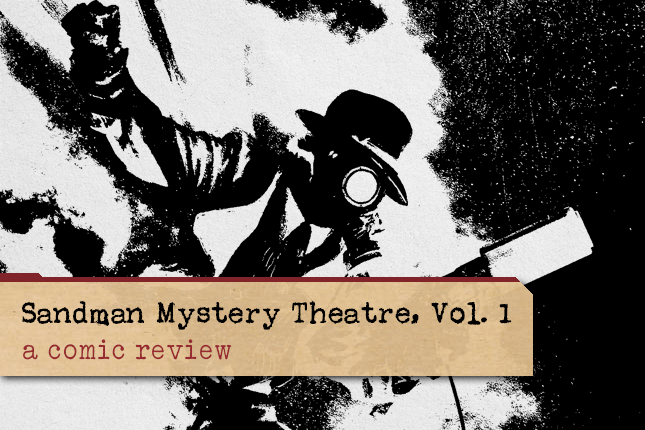
    Wesley Dodds is The Sandman—no, not that one—a 1930’s vigilante armed with a gas mask, a gas gun, and a pocketful of righteous indignation.

    Every night, Dodds falls asleep and dreams horrible nightmares about the monstrous criminals who stalk New York City. The only way to silence his nighttime thoughts is to venture out in the night and bring these foul demons to justice. Yes, we’re in the land of the pulps, ladies and gentlemen. Delicious pulp adventure goodness is where my heart lives rent free, and Sandman Mystery Theatre serves up a nice plate of it.

    This omnibus collects the first 36 issues of the comic and weighs about as much as a Heisman Trophy. If someone comes to rob your house while you are reading, throw this at them and you’ll be charged with murder.

    Dodds makes for an interesting character. The son of a wealthy industrialist, he has the Batman backstory minus the murder. His dad succumbed to a mysterious family illness and now Dodds is the public face of his father’s empire. Unlike Bruce Wayne, who rocks the playboy disguise, Dodds is a bit of a nebbish fuddy-duddy who mostly wobbles around and collects strange looks.

    His girlfriend is Dian Belmont, the daughter of a district attorney and a bit of a wild child who isn’t afraid to move out of step with the times. She’s there to fall in love with Dodds, figure out his deep dark secret, and throw tantrums when she learns the truth. Still, she rings true as a character, but, it feels a bit overshadowed by predictable beats and plotting.

    The fact that Dodds isn’t a super-powered crime fighter is part of what makes this fun. He’s just a shlub in a trench coat. Sometimes he royally screws up in the heat of the moment, which is a nice change from most comic book characters.

    Later, I found out that this is all laying the groundwork for the D.C. Universe and the first Justice League and I swear I groaned so loud I set off a car alarm. I’m just a simple man. I don’t have time for this nonsense. I just want to watch a guy in a fedora beat the hell out of some criminals. If he’s also drowning us in the roar of his blazing .45s, all the better.

    Thankfully, Sandman Mystery Theatre seems to understand this. There are a couple references to other properties sprinkled throughout but they aren’t so on the nose that it takes you out of the story.

    Each arc of the plot is laid out across four issues, each featuring a “monster of the week” criminal for Dodds to take down. Meanwhile, the story of Wesley and Dian and their changing circumstances plows forward like modern day serial television. It makes for some good reading, all in one sitting, but I read that it was hell for newcomers to the series back in the 1990s when it was coming out month-to-month.

    By the end of this huge book, I felt like the four-issue arc structure caused more problems than not. At times, it seemed like writers Steven T. Seagle and Matt Wagner were forced to cram all their ideas into a framework that was often too wide or too narrow for them to maneuver in.

    Still, if you’re in the market for a guy in a mask and a fedora hitting people—and I always am—then you could do a lot worse than Sandman Mystery Theatre. It’s a fun yarn to read through and you’ll totally tone your arms lugging this monster around with you.
  • The Good Asian

    The Good Asian

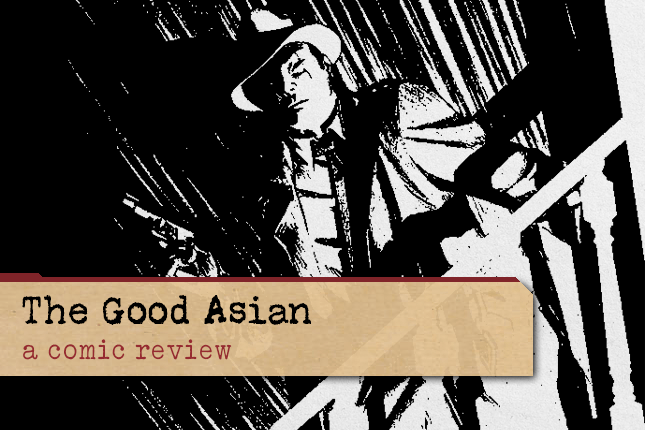
    Edison Hark is one of the first Chinese-American police detectives, working the mean streets of 1930’s Honolulu, when he gets an urgent request from his surrogate brother to come home. Hark was “adopted” by a rich, white family after his mother, who worked for them as a maid, passed away. Now history threatens to repeat itself: The family patriarch has fallen into a coma, and the family’s maid, another Chinese-American, has gone missing. The case is further complicated by the appearance of Hui Long, a mythical boogieman who begins killing his way through the Asian criminal underworld.

    As a man who stands in two worlds but lives in none, Hark is a fascinating character. The whites don’t trust him because he is Chinese, and the Chinese don’t trust him because “Who would give a badge to the Chinese?” as one woman tells him. Even the cops don’t trust Hark, instead using him as an undercover informant or to roust drug addicts from opium dens. He’s quiet, brooding, and self-loathing, made all the worse by living in a time when the U.S. Government has banned Chinese immigrants from entering the country.

    The glimpses behind the scenes of a little-discussed piece of history were fascinating and probably my favorite part of the whole story. Author Pornsak Pichetshote wisely includes a historical supplement at the end, which provides more context for the time and places where the story is set. For a closeted history buff like myself, it was pure gold.

    The mystery itself, however, I liked, but did not love.

    The story takes a few strange dog legs into another character’s point of view. Both times this happens, it unfolds without warning and left me wondering if some pages were missing. Transitions are a useful narrative tool.

    A bigger problem, though, is that the large cast of characters is hard to follow through the twists and turns of the plot. There’s quite a few names to juggle. This isn’t helped by artist Alexandre Tefenkgi’s simple and unadorned style, which makes a lot of characters—I really hate to say—look the same. It rather undercuts the drama when the story drops an important name or a character reveal and you are left asking, “Wait, who is that again?”

    Despite these hangups, I had a good time wandering the streets with Edison Hark. The Good Asian is a nice slice of comic book noir that’ll also teach you a thing or two along the way. What more could you ask for? There’s also a tease in the back of the book that the character will return. I guess I shouldn’t be surprised. The book picked up an Eisner Award for best limited series and there’s rumblings afoot that a movie or TV adaptation might be on the way.

    Count me in.

  • Blacksad

    Blacksad

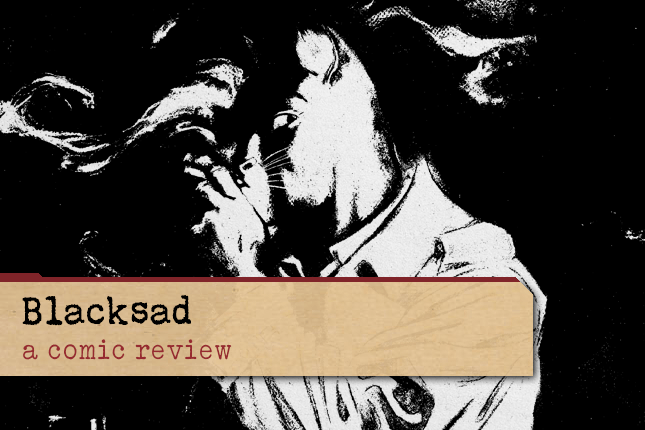
    John Blacksad is a trench coat-clad private investigator on the mean streets of 1950’s America. He’s also a six-foot-tall, anthropomorphized cat with a gun. So don’t rub his belly without asking.

    Blacksad, the graphic novel, includes the first three collected stories in this series: Somewhere within the Shadows, Arctic Nation, and Red Soul.

    Somewhere within the Shadows is easily my favorite of the bunch. It’s a no-nonsense detective yarn. Blacksad’s former flame, Natalia, a starlet of the silver screen, is found shot to death in her home.
    Our hero sets out looking for vengeance. He prowls through the seedy underbelly of Tinseltown, encountering knife-wielding monitor lizards, conniving frog businessmen, punch-drunk gorilla boxers, and corrupt canine cops along the way.

    Think Zootopia, but very R-rated.

    It’s all fairly standard noir stuff, but it’s delivered with grace and style. Juanjo Guarnido’s art is something to behold, a mix of lavish watercolors and expressive characters that come alive on the page in this richly evocative world. It’s no wonder the series has received a ton of prestigious awards.

    The remaining two stories, however, fell a bit short for me.

    In Arctic Nation, a young girl goes missing in a small neighborhood beset with racial tensions. The girl’s mother won’t go to the police, because the polar bear chief is a prominent member of a white supremacist movement. Rumor is that the girl may have been kidnapped by this group, or by the black power group that opposes them. But what would they stand to gain by abducting an 8-year-old? And can Blacksad find her before the streets erupt in a bloody race war?

    In Red Soul, a philanthropic group of scientists and creatives come under suspicion of being communists in disguise. One of their number is killed, but it appears the intended target was Otto Liebber, Blacksad’s one-time mentor and a barn owl with a questionable history. Blacksad sets out to find the killer while the group is set upon by callous FBI agents and a Joseph McCarthy-esque senator with an agenda.

    Both of these stories are fine, well-told little mysteries, but I felt like the larger social angles writer Juan Díaz Canales was exploring fell a bit flat. Especially in Red Soul, the Blacksad’s investigation almost seems like a side plot to a wider examination of the Red Scare and the lingering trauma of World War II.

    It also gets a little weird when they start name dropping folks from history, like Franklin Delano Roosevelt. So, wait, is he like a moose in this or something?

    Honestly, as much as I enjoyed Blacksad as a whole, I kept finding myself pulled out of the narrative by silly little questions like this. What do the characters eat? Like, is there a meat industry? There’s a rooster senator in one story, so chicken is probably off the menu. What about beef? Are cows sentient in this universe?

    These are dumb questions. But they kept bugging me. Why do some animals still have their tails, while others don’t? Blacksad doesn’t have a tail, but we see a wolf with one later. Why isn’t it consistent? Do the cats still use litter boxes? I don’t remember if we ever see a bathroom. Since Aquariums exist, do zoos as well? If so, what do they exhibit in them? Humans? That’d probably be too silly.

    I know, I know, I just need to respect Hodgson’s Law: “Just repeat to yourself it’s just a show, you should really just relax.” But it’s hard when you are enjoying such a fine glass of classic noir and then you have to stop for a moment to wonder if dogs still chase cars or attack the mailman.

    Anyway, if you can look past these quibbles, you’ll find a great take on the classic hardboiled P.I. genre. I can’t wait to read more.

  • Newburn, Vol. 1

    Newburn, Vol. 1

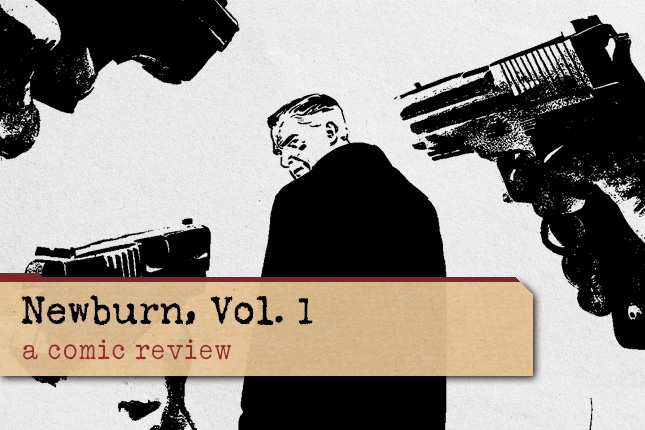
    When a mafioso turns up dead in a crummy apartment and several kilos of coke go missing, Easton Newburn takes the case. He’s a former police detective turned private investigator for the mob. The cops are willing to look the other way, because Newburn keeps the peace between the rival New York crime syndicates.

    Nobody touches Newburn. His word is law, his results unquestioned. He’s unflappable, cold as ice, loyal to no one. He faces down cops and criminals alike. He goes where he likes, when he likes, always the consummate professional in a sleek business suit, never betraying a single emotion.

    Uh-huh. Are you rolling your eyes yet?

    Newburn, the graphic novel, collects the first eight issues of the comic book series written by Chip Zdarsky and illustrated by Jacob Phillips.

    I’m a sucker for stories about criminals and private eyes, so this should have been right up my alley. But I ultimately found it disappointing. That’s mainly because the whole setup feels laughably half-baked. It wants to be gritty and noir, but it doesn’t ring with any authenticity. It’s missing that subtle note of melancholy and hopelessness that underpins the best works in the genre.

    The whole premise that Newburn operates with carte blanche immunity is hard to believe when he is constantly being questioned and threatened by his employers. Wait, I thought he was untouchable? Nobody can lay a hand on him, but when they learn he is investigating a case for the police—which he literally does in every issue, because his ability to navigate both sides of the law is the entire point of his existence—they march him to the end of a pier and put a gun to his head. Wait, what?

    I guess this is supposed to underline the precarious nature of Newburn’s position. It’s a shame, then, that his character is flat and uninteresting. He’s so mannered and unshakable that he never feels like a real person. His dial is permanently set to Stern and Stoic. No matter the situation, Newburn always has evidence, blackmail material, or some other ace up his sleeve. He’s always the one in control, which makes it a little hard to get emotionally invested in the story.

    This lack of characterization extends to his cohorts as well. The crime families are just names on a page that occasionally walk into frame, scream threats, foam at the mouth, then disappear again. Thanks for stopping by, whoever you are!

    Then there’s Emily Walker, Newburn’s protege. The Watson to his aloof and morally gray Sherlock. Emily is street smart and personable, where Newburn is cool and detached. However, it’s hard to get a sense of her personality because we spend so little time with her. In some issues she doesn’t appear at all, and others she only makes an appearance for a page or two. The artist notes in the back of the book point out how her outfits change to signify her evolution throughout the story. I guess they had to depict it visually because it sure doesn’t come through in the writing.

    Later, we learn Emily harbors a Deep Dark Secret(TM) that could turn the New York syndicates against her. This is probably the most interesting development in the eight issues collected here. Would it surprise you to learn that Newburn dispassionately resolves the problem without even breaking a sweat? I mean, why not. In another issue, Newburn has himself arrested on a murder charge so he can investigate an inmate from behind bars. When his investigation is complete, they spring new evidence on the district attorney to immediately exonerate him. Uh-huh. Problem solved! Thank goodness the legal system works so swiftly!

    I’m sorry. I’m just not buying it. I do my best to suspend disbelief, but sometimes it’s a tough hill to climb. I can handle a ridiculous plot if you give me compelling characters, thrillingly choreographed action, or, hell, even just vivid and insightful worldbuilding. But it needs something else. As it stands, Newburn is like an appetizer without an entree. It may quell your hunger, but it’ll never be mistaken for a meal.