Tag: Review

  • Star Wars: The Hutt Gambit

    Star Wars: The Hutt Gambit

    For my first Star Wars extended universe book in 25 years, I thought it would be fun to explore the origins of Han Solo. Disney dropped the ball when they made “Solo,” so I was eager to see what someone else would do with the material.

    The story opens with Han drinking alone in a bar, drowning his sorrows. His dreams are crushed. He’s lamenting a decision that would have made for a much better novel: While serving in the Imperial Navy, Han defied orders and saved the life of a Wookiee slave. His actions saw him stripped of rank and blacklisted from ever working as a commercial pilot.

    A character sacrificing their hopes and dreams to confront a grave injustice would be rich soil for a story to explore, but never mind. Han flies to Nar Shaddaa, the “Smuggler’s Moon,” to find work. He’s joined by the slave he rescued, a Wookiee named Chewbacca who claims to owe him a life-debt. Having seen the movies, we know he means it.

    Han reconnects with an old buddy from the academy and begins his career as a smuggler. This is a lot less exciting than it sounds. We mostly bum around with Han and Chewie as they haul cargo from one place to the next. Later, Han petitions Jabba the Hutt for work, and becomes his chauffer. Then he saves the gangster’s life during a pirate attack, which isn’t very exciting, but it goes on for a while.

    If you squint, you can see the shape of a story here. Han is rebuilding himself after a fall from grace. We witness his rise through the criminal underworld. But it feels like we are reading our way through a sequence that would be a two-minute montage in a feature film. Han meets Lando and teaches him how to fly. Han gets abducted by Boba Fett, then immediately rescued. Han dates a magician, then gets dumped. Han sees the Millenium Falcon for the first time and instantly falls in love with it, because the author has seen the movies.

    There is never an obstacle or setback that isn’t resolved three pages later.

    I complained that the first novel, “The Paradise Snare,” skipped the moments that would have really explored Han’s character. “The Hutt Gambit” has the same problem. It’s very much “tell, don’t show” kind of writing. But “Paradise Snare” at least maintained interest by pivoting in interesting directions—who would have guessed Han spent some formative years running drugs for a religious cult? “The Hutt Gambit” doesn’t have anywhere meaningful to go.

    It culminates in an epic space battle where Han rallies an army of smugglers against the Imperial Navy. It’s meant to be a showstopper. But A. C. Crispin has a hard time conveying the logistics. First, she spends an obscene amount of time with characters announcing their plans to an audience (and the readers). Then the battle itself becomes a slurry of throwaway characters and relentless pew-pew without any real stakes because we know who survives and the rest are thinly-sketched plot contrivances.

    There’s some truly terrible writing in here. Sample dialog: “Mako here. You ready?” “We’re ready!” “Go for it!” Or how about: “We’re being drawn by the moon’s gravity! In about a minute, we’re going to hit Nar Shaddaa’s energy shield! And what an explosion that would be!” Oof.

    It’s a testament to the author’s ability that the book ends up being tolerable. She captures the feeling of Han, Chewie, and Lando well enough to elevate this above bad fan fiction. But only just.

    You can tell this is intended as the middle chapter of a trilogy. We get several asides with other characters that have no relevance on the story we are reading. They are just setting the table for a payoff in the third book.

    I’m hoping that one will be better. “The Hutt Gambit” isn’t bad. But just days after finishing, I had to look up a synopsis online to even remember what happened. That’s probably not what the author intended.
  • Queen: A Chronicle of the Sibyl’s War

    Queen: A Chronicle of the Sibyl’s War

    “Here we go again,” —C-3PO, Return of the Jedi.

    Sometimes you win, sometimes you lose, and sometimes you plow through three mediocre books in thrall to the sunk cost fallacy.

    Queen is the third and final novel in the Chronicle of the Sibyl’s War trilogy. I have reviewed both of the previous novels, but here is a quick recap:

    Nicole Hammond is fighting for control of the starship Fyrantha. The Shipmasters abduct humans to repair the vessel because some humans, like Nicole, can speak to the ship telepathically to find out what needs fixing. The captured humans have accepted this for decades because the Shipmasters have a side gig selling enslaved aliens to serve as conscripted soldiers. Then Nicole came along and blew the lid off things.

    With an uprising looming, the Shipmasters bring in some of their customers to help. The Koffren, big dumb lugs who wear metal masks and carry guns loaded with spider-goo, see an opportunity to take control of the ship for themselves. Meanwhile, Nicole rallies the other slaves together to fight back. But doubt has crept in since Nicole’s plans left a character dead in the last book. I won’t spoil who, because the character was so minor that I forgot his name.

    Author Timothy Zahn has set the stage for this conflict across two books. So how does it play out? Mostly the characters just talk and talk and talk.

    At one point, I almost threw my Kindle across the room. Nicole enters a room and encounters two aliens who want the drone in her possession. The Shipmasters only feed these aliens when they capture a drone for themselves. What follows is about five pages of negotiation. Nicole will not hand over the drone, but her friends will train the aliens how to hunt for one. They explain how to take advantage of the grass and bushes. The aliens can’t follow these instructions. Nicole offers to have her friends capture another drone for them. But the aliens ask what happens if her friends are defeated in combat? Nicole’s friends say they will split up. But what of the water that bisects the room? The aliens can wait on the other side and the friends will throw it across.

    On and on it goes, until the aliens finally just lunge for the drone and the story moves on.

    There are entire conversations in this book that play out like this:

    “I will do the thing.”
    “How will you do the thing?”
    “I will perform the steps.”
    “What steps are those?”
    “I have them in a list here.”
    “Isn’t it dangerous?”
    “Not if we do it carefully.”
    “How will you be careful?”

    I could excuse some leaden dialog if the characters were interesting. Sadly, everyone is straight out of central casting. There’s the angry guy, there’s the sullen gal, there’s the schemer. Half of Nicole’s allies are tough, noble warriors ready to lay down their life for the cause.

    Nicole is supposed to be wise from her time on the streets, but Zahn refuses to give us any insight into what she has seen or done or how that informs her character. Instead, he plays coy with lines like “Not because she was squeamish about watching someone cut off someone else’s head. She’d seen far worse during her time with Trake’s gang.”

    Damn, that implies that Nicole has seen some shit. But she’s so softhearted that Zahn feels the need to remind you, again and again, that Nicole used to be in a gang. Then we we get Philadelphia gang bangers saying things like “crapadoodle” and “freaking butt wipe” and the whole flimsy construction begins to fall apart.

    I normally stay away from online theorizing, but I’ve read some suggestions that this series was a casualty of a tight deadline and publisher meddling. The rumor goes that Macmillan—which only published YA fiction from Zahn in the past—decided to market this to adults and roll the dice. I have no idea if this is true. I mean, I’m just some dweeb on the Internet. But it would explain why the story feels so toothless.

    It’s not a great excuse, though. There are ways to write young adult fiction without pulling your punches. Just look at Joe Abercrombie’s Shattered Sea series.

    Timothy Zahn is a writer of considerable talent and skill, but this time he took the night off.

    There are two back-to-back situations where the heroine seemingly walks into a trap, all is lost, and then — surprise! It was part of her plan all along. Sorry, we just left those details out to drum up some suspense. This kind of narrative trickery works great in a movie like “Ocean’s Eleven” or “Fight Club” where the rug-pull recontextualizes all the scenes that came before it. Here it just smacks of manufactured drama.

    There are even little inconsistencies, like when Nicole says there are still 12 shields that need to be fixed, and a page later, there are still “thirteen gaping holes” in their defenses. Did anybody edit this?

    Never mind.

    Overall, I found all three books underwhelming. I think there is a halfway-decent story here if an editor had condensed them into a single book. I’m left wondering why this had to be a trilogy. Did Zahn sign a contract for three books? Did he stretch his idea to fit? It reads like a draft zero, the early version of a story where an author is still figuring out the characters and plot before tightening it up.

    I’m glad this isn’t my first experience with the author. I know he can do better.

    Crapadoodle indeed.

  • The Sticky

    The Sticky

    Maple syrup is one of those products I just assumed sprang into existence fully formed. Like mangos. Or boulders. But there are apparently farmers who tap trees with spigots to collect the stuff.

    Ruth Landry is a Quebec maple syrup farmer. She is struggling pay the bills and care for her comatose husband. Then the association that regulates the syrup trade revokes her license on a technicality.

    The owner, Leonard Gauthier, wants to force Ruth out of business and buy her land on the cheap. He makes her an insultingly low offer. Ruth responds by hurling a 30-foot maple tree through the association’s front door. Leonard thinks it is a good idea to keep hounding her.

    As my father used to say: Never underestimate a woman willing to throw timber at you. Odds are good she ain’t screwing around.

    Ruth hatches a scheme to rip off the association’s million-dollar maple syrup surplus with the help of Remy Bouchard, the only security guard at the association’s warehouse, and Mike Byrne, a disgraced mobster with poor impulse control.

    The relationship between the three is set up well, building enough sympathy to make you care about the characters when they start breaking bad and making poor decisions. As with most crime comedies, the plot zigs and zags in unexpected ways. Nothing goes according to plan and eventually our crew is in hot water with the police, the mob, and the association.

    The Sticky is a lot of fun. It’s clearly going for a Fargo vibe, especially with their “This is not based on a true story” title card at the beginning of each episode. But it’s missing the distinctive style and well-defined side characters that make Fargo such a singular viewing experience.

    A larger problem is the finale, which left me wondering if there were still more episodes waiting to drop. It felt abrupt–less like a season-end cliffhanger and more like the next chapter of your book is 12 months away. It’ll also be a huge bummer if the show isn’t picked up for future seasons. I think a smidge more resolution would’ve countered this.

    Still, those are pretty minor complaints about a fun, well-crafted crime story. Recommended.

  • Happy Howlidays

    Happy Howlidays

    Guy meets girl. Girl hates guy. But girl must spend time with guy so she can write a blog about their dogs falling in love.

    Welcome to Hallmark movie land, where blandly attractive people with no chemistry stand next to each other in furnished model homes. It’s a winning formula.

    In Happy Howlidays, Mia Park writes a blog for the Seattle Tourism Board. She sleeps in a bed full of potato chips. Her parents want her to move back to Miami, but she pretends to be too busy with work to even talk to them. She also doesn’t like Christmas for some reason.

    On her way home from work, she rescues a dog stuck in a fence, then is bewildered when the pup follows her home. She feeds him some noodles, heads upstairs to bed, then wakes up to find him tearing apart her pillows. She charges downstairs and lands in a puddle of urine.

    “There’s only room for one hot mess around here!” she says, still standing in the pee.

    She tries to dump the dog at Puptown, an animal shelter run by Max Covington — a name that has never existed outside a Danielle Steel novel. Max won’t allow it, but his own mopey mutt takes a shine to Mia’s troublemaker.

    Mia ends up posting a video of the two dogs on the Tourist Board website. Her boss demands more of this scintillating content. “Our site traffic is up 25 percent!” Mia has no choice but to spend more time with Max. Will love blossom? Will Mia find common ground with her parents? Will the shelter find funding to stay open another year? Will someone vacuum Mia’s bed?

    Full disclosure: I don’t really “get” Hallmark movies. My brother Daniel loves them, especially around the holidays. He was the one who insisted we watch this.

    To my untrained eye, the thing that makes a Hallmark movie work is the right amount of sweetness and camp. If you get the balance right, you can overlook the wooden acting, the bland sets, and the lapses in internal logic. “It’s just a Hallmark movie,” people shrug.

    Happy Howlidays is a Hallmark movie. It’s also terrible. There’s no craft or artistry to it. It’s a dumb meet-cute between two unlikable characters that drags on for an hour and a half. The plot is predictable and full of dumb cliches. Even the dogs are an afterthought that exist to bring the characters together and nothing more.

    They do repeat the dog pee gag a few times, though. So if that’s your idea of comedy, then buckle up.

  • Dragons of Etchinstone

    Dragons of Etchinstone

    I wonder if Joe Klipfel owns a table.

    His game design philosophy seems to be: I like this game, but can I play it while standing in line at the deli?

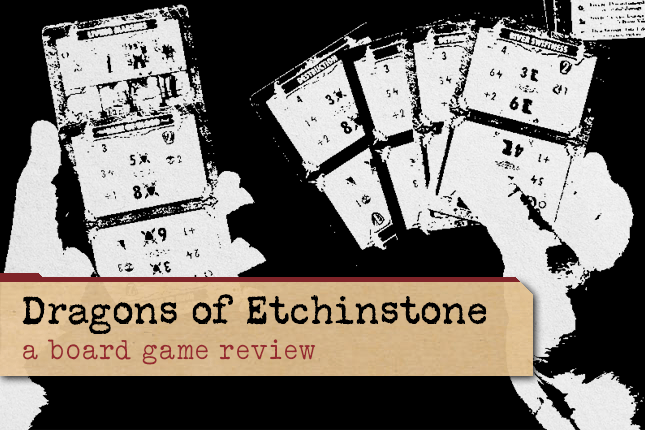
    In Dragons of Etchinstone, a solitaire game designed by Klipfel, you hold a deck of cards in your left hand, representing your draw pile and a set of challenges. Then you play cards from your right hand to defeat them.

    Or, if you’re like me, you set everything on a table. I don’t trust myself. I’m clumsy. All it takes is one fumble and the game is ruined. With a table, I’m fine until I knock the table over or burn the house down.

    Speaking of fire, you play as a wizard adventureman—sorry, an “Ether Mage”—on a quest to kill a dragon. The dragons have occupied strongholds in the four corners of Valorfall and need to be stopped before the peasants learn how to file insurance claims.

    On each turn, you draw four cards. These represent your skills, abilities, and magical spells. The top card of the draw deck tells you what obstacle you face this round. This will either be Combat or a Journey. Both are handled about the same.

    You play three cards to overcome a challenge. Each card fulfills a different mechanical role and activates different elements on the card. Figuring out which cards work best in each role is the central logic puzzle of the game.

    The first card is the Leader. There are two actions listed in the center of each card. One is basic and can be used without restriction. The other has a colored background and only activates if it is “infused” by the second card, the Element. Infusing only works if the color of the Element card matches the background of the action.

    The Element also determines your initiative. This is important in combat. If you don’t beat the initiative, you run the risk of taking damage before the fight even begins.

    Your third card is the Booster. This gives you bonus points that can be spent either to increase the action value on your Leader card, or to bump up your initiative.

    The fourth unplayed card usually remains in your hand into the next round.

    As you can see, Dragons dives headfirst into gamey abstraction. This is the point where most games lose me. I’m a narrativist. My enjoyment of a game derives from how well it tells a story. If the mechanics of play are too abstracted from the action of the unfolding story, I struggle with it. In Horrified—another game I love despite some narrative nonsense—isn’t it odd that you might go into battle with Dracula wield a fire poker, a canopic jar, and a kite? Maybe the crossbar reminds Vlad of a cross.

    In Dragons, I guess we’re to assume that the cards symbolize us weaving an arcane spell together? It’s a little thin. There’s a delicious Netrunner-esque retheme lurking in the back of my head that I think would be way better. But the core gameplay loop is so engrossing that I don’t care.

    If you overcome the challenge, or reduce the challenge’s value by half, then you earn experience points. You spend these to upgrade your cards. Each card is divided in half and there are alternate front and back sides. This gives each card four possible permutations. Deciding which to upgrade is a cornerstone of your strategy. But so is knowing which cards to downgrade.

    See, your cards also act as your health in combat. Each has a shield value on it that can absorb a set amount of damage. If the card takes a hit, then it gets downgraded one level. Reducing a card below level 1 means it is removed from the game. Ouch. Each card can only be downgraded once per encounter. So, if all four cards have 2 Armor and you take 9 damage, then you’re going to have a bad time.

    During Journey encounters, you don’t have to worry about soaking damage. Instead, you suffer time penalties. This means taking cards off the draw pile and discarding them. When the deck runs out, you move into the next region and face off against even tougher obstacles. Complete the fourth region and you head into the final battle with the dragon.

    There’s a ton of nuance here—especially when you consider that the entire game is just 18 cards. Eighteen! And I’ve only just scratched the surface. There are also different colored armors, which absorb and protect against different damages; fusing cards together to form a wildcard color at the cost of depleting your deck faster; ways of dealing double boosts during journeys, icons that add one-time modifiers to your encounter, and more.

    There’s a lot to the game. Which leads to my one real negative opinion: Dragons of Etchinstone is simple to play, but hard to learn. I read the rulebook a few times and could not grok how it all fit together. I bounced off it like a Nerf dart on a Sherman tank. There were too many terms and icons and numbers and mechanics. Looking at the cards was no help. They look like if J. R. R. Tolkien wrote math flash cards. They are impossible to decipher without guidance.

    I almost gave up on the game until I remembered we live in a world of Let’s Play videos. A few of these under my belt, everything became clear. I think it’s a game you really need to see in action to understand. Or maybe that’s just my hangup.

    Regardless, Dragons of Etchinstone is a wonderful little puzzle. It’s a solid piece of design that provides a wonderful dollop of brain friction. I can’t recommend it enough. Why not go down to the deli RIGHT NOW, stand in line, and give it a play.

    I’m sure no one will look at you strangely.